

On May 15, 2026, the Supreme Court of Canada issued its long-awaited judgment in Ahluwalia v. Ahluwalia, 2026 SCC 16, recognizing a new common law tort of intimate partner violence. Beyond its significance for victims and survivors of domestic violence, the majority’s reasons in Ahluwalia provide helpful guidance on the development of new tort law generally — guidance that is likely to shape Canadian tort law for years to come.
A new tort of intimate partner violence
In Ahluwalia, a majority of the Supreme Court of Canada found that a new tort of intimate partner violence should be recognized in Canada.
Writing for a five-member majority, Kasirer J. held that this new tort requires a plaintiff to establish three elements: (i) first, that abusive conduct arose within an intimate partner relationship or its aftermath; (ii) second, that the defendant intentionally engaged in the abusive conduct; and (iii) third, that the conduct, assessed objectively, constituted “coercive control”.
Prior to Ahluwalia, Canadian tort law provided only limited civil remedies for victims and survivors of domestic violence, including claims for battery, assault or intentional infliction of emotional distress. At paragraph 182 of its reasons, the majority explained why these existing causes of action were insufficient and called out for a distinct tort:
The new tort of intimate partner violence fills a gap in the common law by properly recognizing that conduct objectively resulting in domination and control of an intimate partner is a qualitatively distinct wrong from those wrongs redressable through existing torts. It is the intimate partnership context that enables the abuser to exert control over their victim. Liability arises because coercive control constitutes an interference with an intimate partner’s autonomy; it is inherently incompatible with an intimate partnership as it renders the partnership unequal and results in dignitary harm, alongside, but distinct from, the physical or psychological harm that can be caused by abuse.
The recognition of this new tort is a landmark development in Canadian law. Its implementation will undoubtedly raise difficult and consequential questions for litigants and courts alike — including how to distinguish actionable “coercive control” from non-actionable interpersonal grievances or vindictive behaviour. Even so, Ahluwalia represents a groundbreaking development in the common law of intentional torts.
Incrementalism and necessity remain defining features of Canadian tort law
It is not often that the common law expands through the creation of new torts.
As the majority observed in Ahluwalia, the development of tort law “is shaped by the same concerns for caution and boldness that characterize judicial changes in the common law more generally” (para. 68):
On the one hand, courts are the “custodians of the common law”, and on them rests the “duty to see that the common law reflects the emerging needs and values of our society”. On the other hand, “in a constitutional democracy such as ours it is the legislature and not the courts which has the major responsibility for law reform”, and upon this responsibility the judiciary cannot intrude. [Citations omitted.]
Two principles continue to guide — and constrain — the recognition of novel torts: incrementalism and necessity. Through incrementalism, developments in the common law occur ploddingly: “new rules in tort law ‘come into existence only by a series of analogical extensions spread over a long period of time’” (para. 72). Closely connected to this principle is necessity: rooted in corrective justice, necessity requires the absence of adequate existing remedies before a novel tort may be properly recognized. As Kasirer J. noted, “Canadian common law has long balanced the need for principled evolution against that of preserving predictability and coherence” (para. 95).
These long-standing principles help explain the very slow pace at which novel torts develop, with only a smattering of examples from recent decades in Canadian law:
- Tort of negligent investigation – In 2007, a majority of the Supreme Court of Canada recognized a tort of negligent investigation, creating a new private law remedy against investigating police officers (Hill v. Hamilton-Wentworth Regional Police Services Board, [2007] 3 S.C.R. 129);
- Tort of intrusion upon seclusion, for breach of privacy – In 2012, the Ontario Court of Appeal recognized a new privacy tort protecting against intrusion upon seclusion, emphasizing the fundamental importance of an individual’s right to privacy in a modern digital society (Jones v. Tsige, 2012 ONCA 32).
- Tort of public disclosure of private facts – In 2016, the Ontario Superior Court recognized a tort directed at protecting against the public disclosure of embarrassing private facts, including, for example, the distribution of intimate images (Jane Doe 464533 v. N.D., 2016 ONSC 541). This tort has since been recognized at common law in other Canadian jurisdictions, including Nova Scotia (Racki v. Racki, 2021 NSSC 46), Alberta (ES v. Shillington, 2021 ABQB 739) and Saskatchewan (S.B. v. D.H., 2022 SKKB 216).
Courts tend to exercise even greater restraint where statutory remedies already exist. One recent example is Moon v. International Alliance of Theatrical Stage Employees (Local 891), 2025 BCSC 2238, where the Supreme Court of British Columbia declined to recognize a novel common law tort of public disclosure of private facts in British Columbia, despite its recognition elsewhere in Canada. As noted by Morley J. in Moon, while a “nominate tort of public disclosure of private facts would reflect and address a wrong by one person on another, there already exist alternative remedies” under British Columbia’s statutory privacy regime, including the Privacy Act, RSBC 1996, c. 373 and the Personal Information Protection Act, SBC 2003, c. 63 (para. 172).
A “consolidated framework” for the recognition of new torts
Prior to Ahluwalia, a leading framework for the recognition of new tort law in Canada was found in the dissenting opinion of Brown and Rowe JJ. in Nevsun Resources Ltd. v. Araya, 2020 SCC 5. In Nevsun, the court considered, but declined, to recognize new domestic torts based on violations of customary international law (e.g. slavery as a violation of international norms).
In addressing the new domestic tort issue, Brown and Rowe JJ. articulated “[t]hree clear rules for when the courts will not recognize a new nominate tort” [emphasis added] (para. 237): “(1) The courts will not recognize a new tort where there are adequate alternative remedies; (2) the courts will not recognize a new tort that does not reflect and address a wrong visited by one person upon another; and (3) the courts will not recognize a new tort where the change wrought upon the legal system would be indeterminate or substantial.”
In other words, the dissenting judges in Nevsun made clear that “for a proposed nominate tort to be recognized by the courts, at a minimum it must reflect a wrong, be necessary to address that wrong, and be an appropriate subject of judicial consideration” (para. 237).
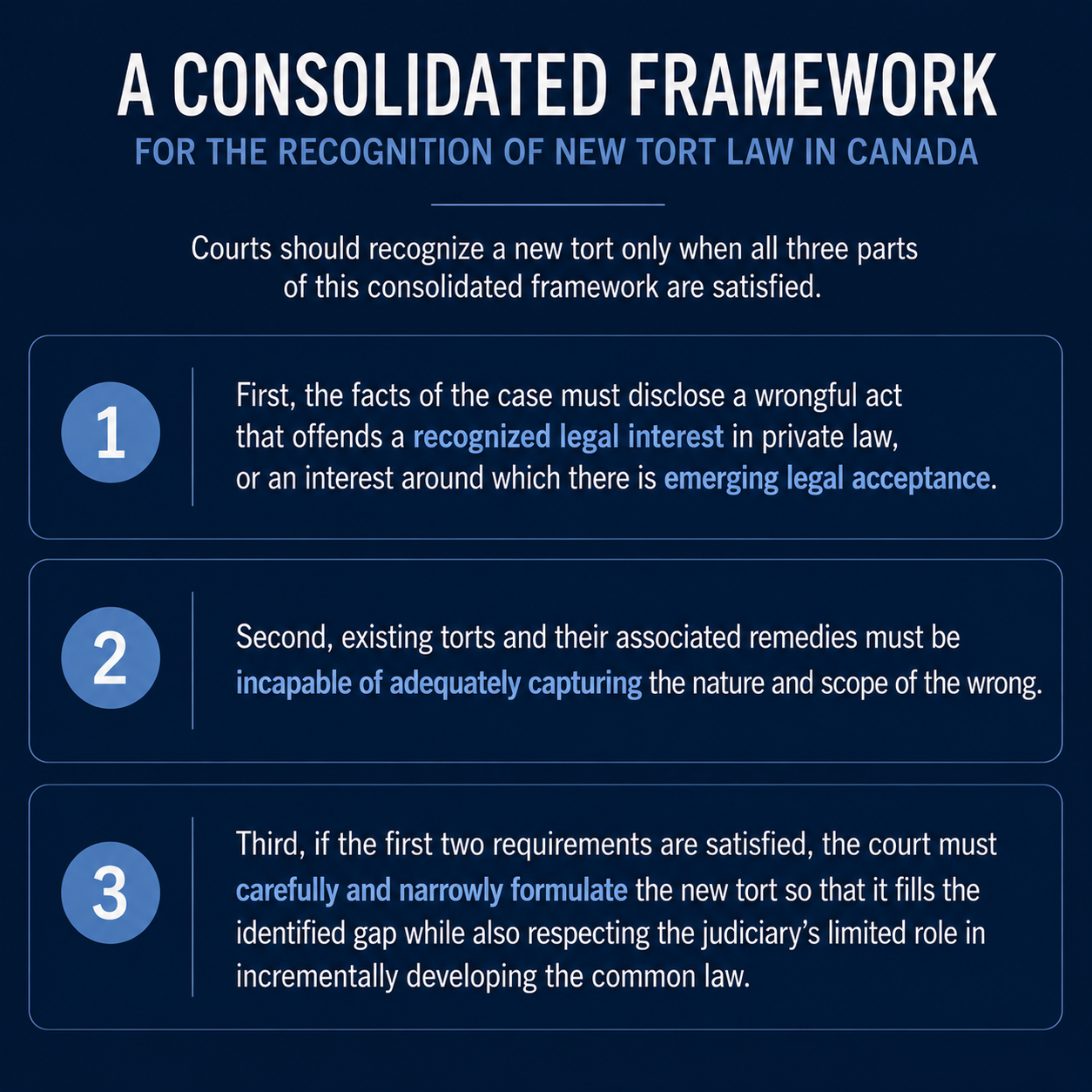
Six years later, the majority in Ahluwalia has adopted and refined these principles into the following three-part “consolidated framework” to guide courts in determining whether a novel tort should be recognized (para. 83ff):
(1) First, the facts of the case must disclose a wrongful act that offends a recognized legal interest in private law, or an interest around which there is emerging legal acceptance;
(2) Second, existing torts and their associated remedies must be incapable of adequately capturing the nature and scope of the wrong; and
(3) Third, if the first two requirements are satisfied, the court must carefully and narrowly formulate the new tort so that it fills the identified gap while also respecting the judiciary’s limited role in incrementally developing the common law.
In articulating these “cumulative requirements” for the recognition of a new tort in Canadian law, Kasirer J. further emphasized the importance of preserving predictability and coherence: “[r]ecognition of novel torts must be rare, cautious, and rooted in the incrementalism that reflects appropriate judicial restraint” (para. 95).
The future of new tort law in Canada
Though still exceptionally rare, we have recently witnessed a growing trend of judicial creativity and dynamism when it comes to the recognition of new and novel torts in Canadian common law. For plaintiffs, this trend modestly expands the possibility of obtaining a meaningful civil remedy where existing torts are a poor fit. For defendants, it correspondingly increases the prospect of complex and protracted litigation (think: potential appeals) to address and defend against the recognition of new and novel torts.
At least one principle, however, remains constant: judicial restraint continues to sit at the core of novel torts and their development.